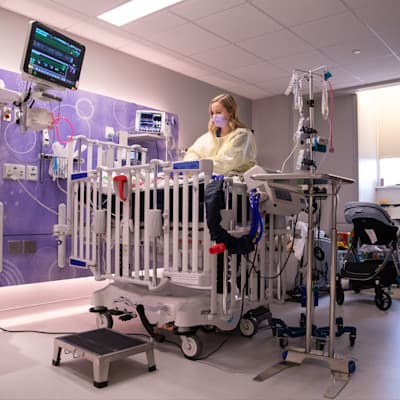
ECMO: What to Know About Life Support for Children
Learn what ECMO is, how it works, criteria for ECMO and what to expect from your ECMO team at Children’s Nebraska.
Nov. 18, 2026
What is Extracorporeal Membrane Oxygenation (ECMO)?
Extracorporeal membrane oxygenation (ECMO) is a type of life support your child may need when they have severe breathing or heart problems. While on ECMO, their body gets a break, so it can heal.
“ECMO is the highest form of life support,” said Amanda Klavins, manager of ECMO services at Children’s Nebraska. “The machine takes over the role of either the heart and lungs or just the lungs, depending on the kind of support a patient needs.”
Types of ECMO for Children
There are two main types of ECMO:
Venovenous ECMO (VV): Supports your child’s lungs, while their heart continues to function on its own.
Venoarterial ECMO (VA): Supports your child’s lungs and heart.
How ECMO Works
How your child receives ECMO depends on their illness. Typically:
The surgical team inserts one or two cannulas (thin, flexible tubes) into the child’s neck, chest or groin (or both). The cannulas connect your child’s circulatory system with the ECMO machine.
The pump pulls the blood from the cannula in a vein to an external oxygenator (artificial lung). The oxygenator does the work of the lungs. It adds oxygen to the blood and removes carbon dioxide.
The blood with oxygen goes back into the body into either a vein or artery.
If your child receives VA ECMO, an external pump also helps move their blood throughout the body. There is an external pump for both forms. If it returns to an artery, it is bypassing the heart which is how it provides heart support.
Why Would My Child Need ECMO Support?
Your child might need ECMO if recovery is possible, but other treatments haven’t improved their heart or lung function. Common conditions that require ECMO include:
Heart defects
Congenital heart disease
Heart surgery
Respiratory distress
Sepsis or severe infection
Viral lung conditions, such as pneumonia
“If the lungs and heart can’t function on their own, Conventional medical therapies are failing or the ventilators are doing so much work that we could cause damage to the lungs or body in the long run, we’ll put them on ECMO,” Klavins explained.
What Should I Expect if My Child Needs ECMO?
Most of the time, an intensive care unit (ICU) doctor will talk to your family about ECMO, including its risks and benefits. This can help you decide if you want to use this treatment approach. Some emergency cases require immediate use of ECMO.
Once your child is on ECMO, you’ll see a lot of people in their hospital room, including an ECMO specialist who stays with them 24/7. Your child will receive:
Blood tests at least every four hours
Daily X-rays
Echocardiograms at least once a week
Anticoagulation medications to prevent the machine from clotting off
Head ultrasounds if they’re a baby
Your ECMO specialist makes sure your child stays safe. They monitor the ECMO machine, adjusting oxygen and carbon dioxide levels and blood flow as needed.
ECMO Specialists and Care Team
ECMO requires multidisciplinary collaboration from a full team to keep patients and families informed every step of the way while working to ensure children remain as comfortable as possible. Families can feel confident knowing their child is cared for by an experienced ECMO team. As a three-time recipient of the Extracorporeal Life Support Organization's (ELSO) Award of Excellence at the platinum level, Children’s has been recognized for its commitment to the highest standards of care.
Your ECMO team may include but is not limited to:
ECMO specialists
Intensive care physicians
Intensive care nurses, usually from the Cardiac Care Unit (CCU) and Pediatric Intensive Care Unit (PICU)
Surgeons
Nephrologists if your child is on dialysis
Perfusionists
Physical therapists and occupational therapists
Respiratory therapists
An interpreter if needed
How Long Will My Child Be on ECMO?
Every child’s ECMO journey is different, including the length of time they stay on ECMO. Some children only need ECMO for a few days, while others with severe lung or heart conditions may require it for several weeks or months. Ultimately, the duration depends on:
Past medical history
The underlying illness or injury
How quickly the heart or lungs recover
The patient’s overall health
Whether complications occur during treatment
Activity Levels During ECMO
The activity levels of children on ECMO also vary widely depending on their underlying condition.
“If they’re on ECMO after heart surgery, they’re probably heavily sedated and not awake,” said Klavins. “But if they’re on ECMO for something like pneumonia, usually, we try to wake them up, walk and do rehab because the conditioning helps them gain the strength to help their lungs breath.”
Klavins also notes that at smaller centers, a child is more likely to remain heavily sedated while on ECMO due to limited resources or experience. Movement with ECMO requires careful planning, specialized child-focused equipment and team coordination. The ECMO program at Children’s has been around since 2004 and has grown both in size and capabilities.
Recovery After ECMO
As your child gets better, their ECMO specialist will start to reduce how much support the ECMO machine provides. They make sure your child’s heart and lungs are ready before removing the cannulas. After removal, your child usually starts out with a breathing tube, since they still have a road to recovery. They’ll work with physical therapists, occupational therapists and others for rehabilitation.
Recovery times vary by person. If your child has been walking around while on ECMO and doing exercises, they’ll likely have a shorter recovery and be able to leave the hospital sooner. Read more about ECMO recovery in Eduardo’s story. During his 65 days on ECMO he was able to reach his goal of walking across the stage at his high school graduation.
Other Common Questions About ECMO
Explore More
Neonatology (NICU)
Pediatric Intensive Care Unit (PICU)