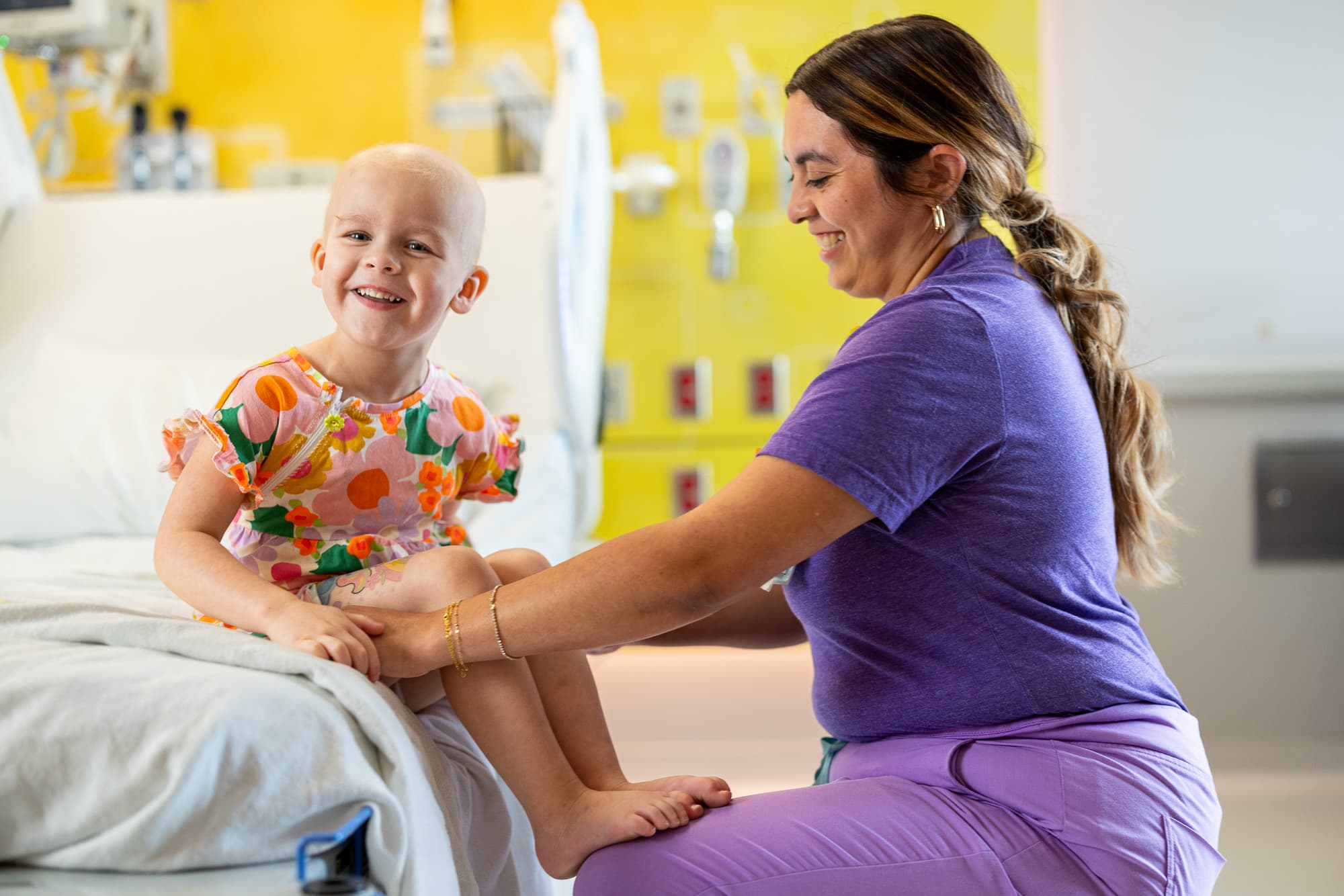
Explore a Career as a Cardiac Care Nurse
Critical care nurses in the Children’s Nebraska Cardiac Care Unit find deeply meaningful work building their acute-care capabilities. Learn the credentials you need, the professional development you’ll receive and how our team helps prevent bedside burnout.
Nov. 27, 2026
What Is It Like to Be a Pediatric Cardiac Care Unit Nurse?
Nurses in Children’s Nebraska’s Cardiac Care Unit (CCU) have immensely rewarding healthcare careers. Our team members build advanced critical care skills while caring for pediatric patients who require the highest level of clinical expertise.
Patients in the CCU have congenital heart disease or acquired heart disease. They may be recovering from cardiac surgery, awaiting a heart transplant, requiring mechanical circulatory support or receiving ongoing care for complex heart disease. As the only pediatric CCU in the region, our cardiac nurses treat patients from admission to discharge, providing a seamless continuum of care.
In our CCU, nurses are part of a highly collaborative environment where team members work together to deliver exceptional patient care. The unit’s strong sense of camaraderie contributes to high team member satisfaction and retention rates, while the nature of cardiac critical care allows nurses to build meaningful, lasting relationships with patients and their families, who often spend extended periods of time in the unit. Nurses partner closely with:
Advanced practice providers (APPs)
Cardiac anesthesiologists
Cardiac intensivists
Cardiologists
Cardiothoracic surgeons
Cardiac diagnostics professionals
Nursing leadership
Pharmacists
Rehabilitation services
Other consulting specialists and support staff
Katina Archie, Cardiac Care Unit clinical nursing manager, has worked at Children’s throughout her entire career.
“Every single person who works here wants to be here and truly wants to provide the best care to their patients,” Archie says. “When I speak to families, they light up when they talk about the nurses and the entire team.”
Our mission-driven teams are dedicated to a People First culture, built on pillars of purpose, joy, learning and growth, wellbeing and belonging. Children’s also offers competitive ICU nurse salaries, benchmarked annually against industry data, along with comprehensive benefits.
Responsibilities of a Bedside Nurse in a Pediatric Cardiac Care Unit
“No day is ever the same,” Archie says. “We have varying levels of acuity for the ICU-level patients. Patients who are receiving continuous renal replacement therapy (CRRT) or extracorporeal membrane oxygenation (ECMO) require a high level of care. All our nurses are trained across the board from acute care cardiology to ICU-level care.”
CCU bedside nurse responsibilities include:
Administering and titrating medications, including vasoactive medications
Caring for patients who require mechanical circulatory support, including ventricular assist devices (VADs)
Caring for mechanically ventilated patients and patients with a tracheostomy
Monitoring hemodynamics
Incorporating play and interaction into daily care to support each child’s development
Intubating patients
Managing central lines and arterial lines
Providing family education and support
Recognizing and responding to clinical deterioration
What Degree Do You Need to Become a Pediatric Nurse in a Cardiac Care Unit?
To become a pediatric ICU nurse, you need to complete an accredited nursing program and earn an RN license. “The gold standard for CCU nursing is the Critical Care Registered Nurse (CCRN) certification,” Archie says.
Nurses can also qualify as a pediatric ICU nurse with a Certified Pediatric Nurse (CPN) certification.
How to Become a Cardiac Care Unit Nurse at Children’s Nebraska
Steps to becoming a Children’s CCU nurse include:
Apply online
Interview in-person or virtually
Tour the CCU
Shadow another team member
New graduate nurses in our Nurse Residency Program enroll in a tiered orientation, first working with patients up to a stable ICU level. After working independently for about a year, they return to orientation to learn to care for more critically ill ICU patients.
“New nurses have time to develop time management, prioritization and delegation skills,” Archie says.
What Professional Development Opportunities Does Children’s Offer Nurses?
Children’s has achieved Magnet recognition from the American Nurses Credentialing Center (ANCC)’s Magnet® with Distinction, the highest honor for nursing practice. As an approved and accredited provider of continuing nursing education (CNE), we offer many professional development opportunities to help nurses meet their continuing education (CEU) requirements, including:
Advanced cardiac anatomy lectures
Cardiac arrest prevention (a case review anytime a patient has a cardiac arrest)
Monthly Heart Smart lectures
Specialized certifications
Transition to Pediatric Nursing program
Professional development opportunities for experienced nurses include:
Continuous renal replacement therapy (CRRT) bedside training
Extracorporeal membrane oxygenation (ECMO) bedside training
Ventricular assist device (VAD) training on four different types of devices
CCU nurses also participate in weekly collaborative multidisciplinary assessment of performance (CMAP) rounds.
“We discuss every single surgical patient we saw the week before as a team,” Archie says. “We talk about what happened in the operating room, what happened post-op, what went well and what we could improve.”
Children’s also offers preceptor classes, allowing more seasoned nurses to train new nurses.
How Does Children’s Prevent Bedside Nurse Burnout?
“We have a lot of amazing programs here at Children’s to support work-life balance for nurses,” Archie says.
Comprehensive wellbeing resources include 24/7 individual or group support through our THRIVE program, as well as bereavement support.
“Every nurse has a mentor we set them up with when they start,” Archie says.
Charge nurses are present on every shift, and four supervisors, two on days and two nights, have direct reports. They check in with the team often, watch for signs of someone struggling with work-life balance and help ensure appropriate coping mechanisms are in place.
Archie’s son had a congenital heart disease, which is why Archie chose to be a cardiac nurse.
“This was the only place I wanted to work,” she says. “Children’s is something very special. This is my second family, my home away from home. I can’t imagine working anywhere else.”