Merrit's Story: Back on the Court After Beating a Cancerous Spinal Cord Tumor
Merrit overcome a spinal cord tumor with expert pediatric neurosurgery, neuro-oncology care and advanced MRI technology at Children's Nebraska.
Oct. 22, 2026
When 17-year-old Merrit began experiencing persistent neck pain and back pain, he assumed it was something simple. Maybe he had slept wrong. Maybe he needed a different pillow. As an active student-athlete, he never imagined the pain would lead to a spinal cancer diagnosis.
What followed not only tested Merrit and his family, but it also demonstrated the power of comprehensive neuro-oncology care at Children’s Nebraska. Neurosurgeons, cancer specialists, therapists, nurses and rehabilitation specialists worked together to deliver life-saving treatment close to home.
From Persistent Pain to a Cancerous Spinal Cord Tumor Diagnosis
Merrit thought the pain in his neck and back was something minor, but as his discomfort and his mobility worsened, it became clear something more serious was happening.
As Merrit's symptoms worsened, doctors referred him to the Emergency Department at Children's Nebraska, where an MRI revealed the cause: cervical ependymoma, in his case a cancerous spinal cord tumor stretching the span of his cervical spine.
His mother, Abby, still remembers the fear and uncertainty she and Merrit’s father, Eric, felt. .
"Hearing his diagnosis was the worst news we could have ever received. It was frightening. We were beyond scared. I made myself sick just not knowing, and your thoughts are just racing and you’re wondering what it all means. It was the worst 24 hours of my life," she said.
Receiving a Spinal Ependymoma Diagnosis
Ependymomas are tumors that can form in the brain or spinal cord. In Merrit’s case, the tumor affected a delicate area of the cervical spine, the portion of the spine within the neck.
Symptoms of spinal ependymoma can include:
Persistent pain in the neck that doesn’t improve with rest or treatment
Arm or leg muscle weakness
Numbness or tingling in the arms, legs or torso
Difficulty walking
Loss of control of the bowels or bladder
Trouble breathing, speaking or swallowing
A Turning Point at Children’s Nebraska
The search for answers led to multiple doctor visits, weeks of uncertainty and mounting concern, but once they arrived at Children’s Nebraska, the difference was immediate.
"It just felt like we were in the right spot," Abby said. "Immediately, they were very understanding and reassuring. We felt like they knew what they were doing, and it just felt like the right place."
At Children's Nebraska, Merrit and his family found a team ready to walk beside them every step of the way. He received a full central nervous system MRI, met with pediatric neurosurgeons Afshin Salehi, MD, MS, and Meena Vessell, MD, and consulted with neuro-oncologist Chittalsinh Raulji, MBBS.
Before deciding on a plan, the team reviewed Merrit's results side by side. Together, they weighed the options and scheduled an urgent surgery.
This close collaboration continued long after surgery, with surgeons and oncologists visiting Merrit together, coordinating with radiation specialists and gathering as a group for tumor board discussions. That kind of teamwork shown by the pediatric neurosciences and the pediatric hematology and oncology teams is at the heart of multidisciplinary pediatric neuro-oncology care at Children’s.
Personalized, Expert Neuro-Oncology Care
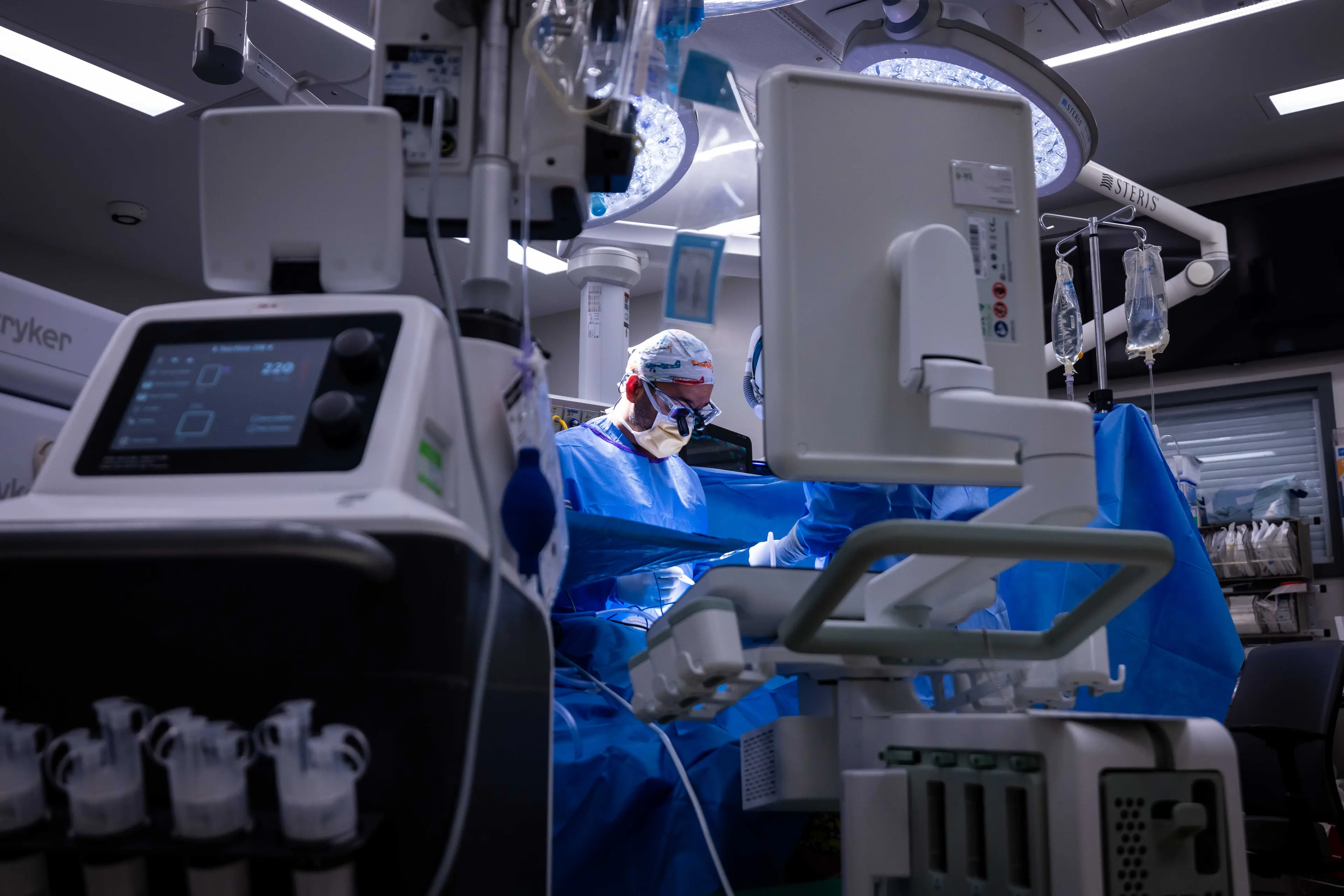
The tumor extended across much of the cervical spine, requiring a lengthy and delicate procedure. The spinal cord leaves very little room for error, and Dr. Salehi didn't sugarcoat the challenge ahead.
"The spinal cord itself is not forgiving. If you look at it wrong or move it a little bit too much, it will malfunction. So, this type of surgery can be highly specialized and challenging," he said.
One tool gave Merrit's surgical team a powerful advantage: an intraoperative MRI (iMRI) scanner.
Precision Through Innovation: The Role of iMRI in Surgery
iMRI supports complex tumor surgery in many ways such as:
Provides MRI imaging during surgery without requiring a separate procedure
Helps neurosurgeons determine whether additional tumor tissue remains after inital resection
Guides the neurosurgeons to achieve total tumor removal where safe and possible
Assists surgical decision-making in real time
Gives the neurosurgeons immediate feedback before the operation is complete
Despite the complexity, the surgeons achieved what they hoped for.
"We were very happy with the outcome during the operation. We got an excellent neurological outcome for him," Dr. Vessell said.
Pediatric Cancer Care Beyond the Surgery
Removing the tumor was a major milestone, but Merrit's journey wasn't over. He went on to complete 28 rounds of targeted radiation and had access to the latest clinical trials and treatment protocols. He also completed hours of physical and occupational therapy.
Just as important, his care reached far beyond the physical body, supporting his transition back to school and daily life.
Dr. Raulji says that comprehensive support is what sets Children’s program apart.
Families benefit from a coordinated team that includes:
Pediatric neuro-oncology specialists
Pediatric neurosurgeons
Hospitalists
Neuropsychologists
Rehabilitation services specialists such as physical therapists and occupational therapists
Social workers
Behavioral health specialists
School transition support
Having every team under one roof means families like Meritt’s don't have to piece together care from scattered providers. At Children’s, the experts come to you.
That collaborative approach stood out to Abby and Eric throughout their son's treatment.
"I just feel like everyone cared," she said. "And they were very open and honest. They had to deliver us some pretty scary and potentially unfortunate news, but they did it in a way that we still felt good about the team doing it. We knew there were risks, but we still felt like we were in the right place."
Back in the Game: Life After Childhood Cancer
Today, Merrit is cancer-free. He has no deficits after surgery and has seen improvements in strength, numbness and breathing. He returns for monitoring scans every three months and is back to the life he loves: his senior year of high school, weightlifting, basketball and serving as a football team captain.
Dr. Raulji said Merrit's recovery reflects both the care he received and the mindset he brought to every step of the process.
Merrit’s parents agree.
"Merrit had the best attitude the whole time," Abby said. "He never complained once. From the time he found out that it was a cancerous tumor, he just said, ‘We're going to beat it. It'll be fine.’"
Looking to the Future
Merrit’s journey gave him a new appreciation for the everyday things many of us overlook.
"If I didn't have this happen to me, I probably wouldn't have appreciated everyone around me," Merrit said.
The experience even influenced his future plans. Inspired by the imaging professionals who helped diagnose and monitor his tumor, he hopes to pursue a career in radiology technology.
"Going through all this and seeing how the doctors and the people behind the scans help me, I want to do that with other people," he said. “I just want to say thank you.”
Why Families Choose Children's for Pediatric Neuro-Oncology
Merrit's story is a reminder that even the most frightening diagnosis can lead to a hopeful outcome when the right team stands beside you. At Children’s Nebraska, patients and families can count on:
Trusted expertise: Skilled pediatric neurosurgeons and neuro-oncologists with deep experience in bran and spinal cord tumors and childhood cancer.
Multidisciplinary care: Surgeons, oncologists, therapists, social workers and specialists working side by side, all in one place.
Advanced technology: Tools, including intraoperative MRI, that make complex surgery safer and more precise.
Research-backed treatment: Access to the latest clinical trials.
Whole-child support: Emotional, academic and family resources at every step.
You don't have to face a pediatric cancer diagnosis alone. The team at Children's Nebraska surrounds each child and family with expert, compassionate care from diagnosis through recovery.
To learn more or schedule an appointment with the Hematology/Oncology program at Children’s Nebraska, call 402.955.3950. To learn more or schedule an appointment with the Neurosurgery program, call 402.955.8600.